At Stand, we simulate how a wildfire behaves around individual homes using our physics-based World Model. To date, we have insured $10B in home value leveraging our models. However, fire science remains an understudied field. This summer we started running our own burn experiments to extend our insights into how real building materials and plants behave in a fire. Pairing simulation with real burn tests refines our assumptions, sharpens how we understand risk, and ultimately helps us develop better mitigation methods to better protect our customers.
The first tests focused on two things: how embers damage a deck, and how moisture content affects how a shrub burns. Both extend recent lab research toward conditions closer to those found in the field, including a study by a member of our team investigating how moisture affects the ignition of Douglas fir branches (Valdivia et al., 2025).
How Embers Damage a Deck
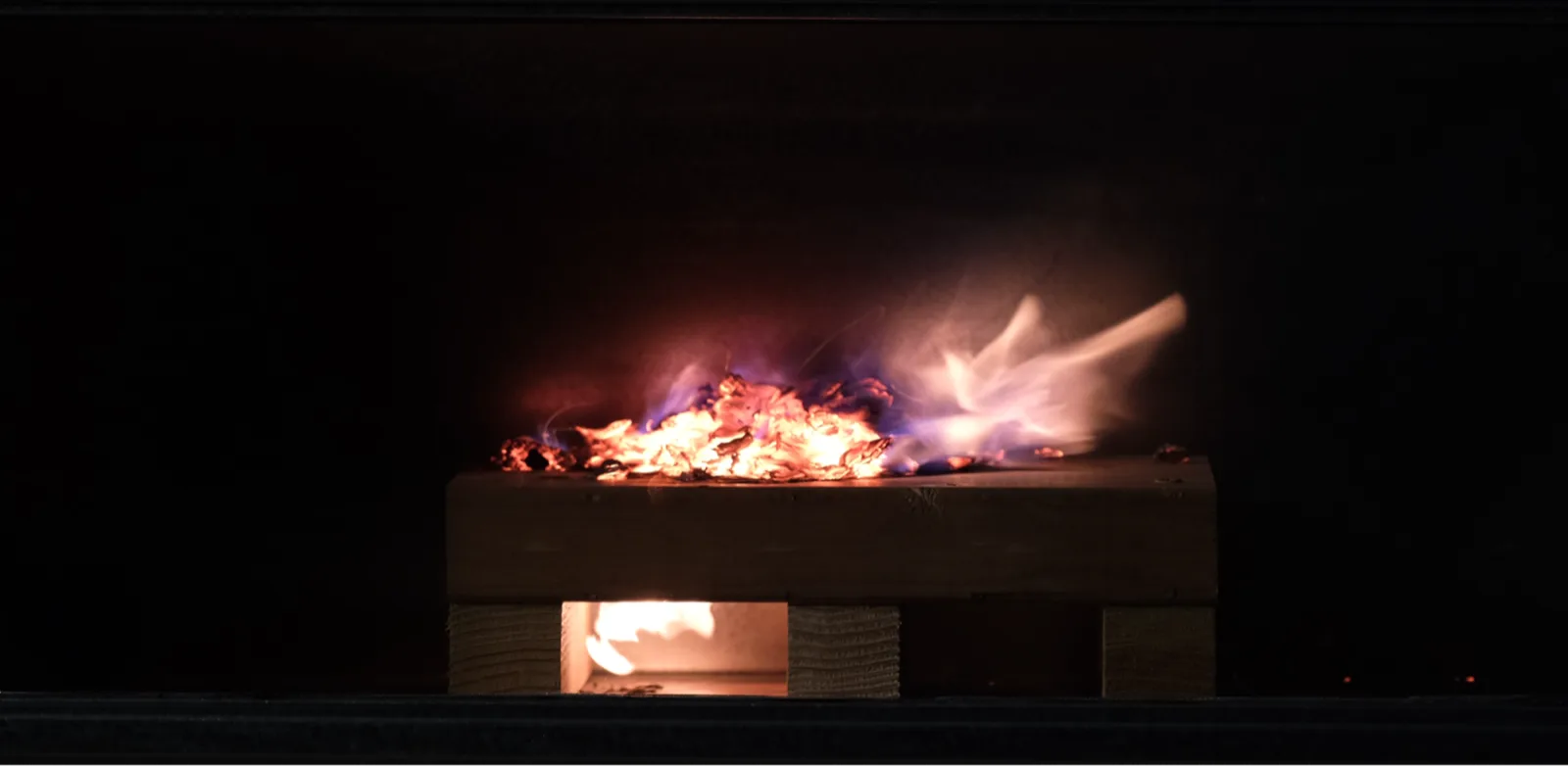
Embers are one of the most common ways homes ignite in a wildfire. They are small pieces of burning bark and twigs carried by the wind, often well ahead of the fire itself. They float through the air and accumulate on decks and in corners where they often keep smoldering after they land. A recent lab study found that small piles of glowing embers can burn through wooden deck boards, and that wind speed had the largest effect (Mohamed et al., 2026).
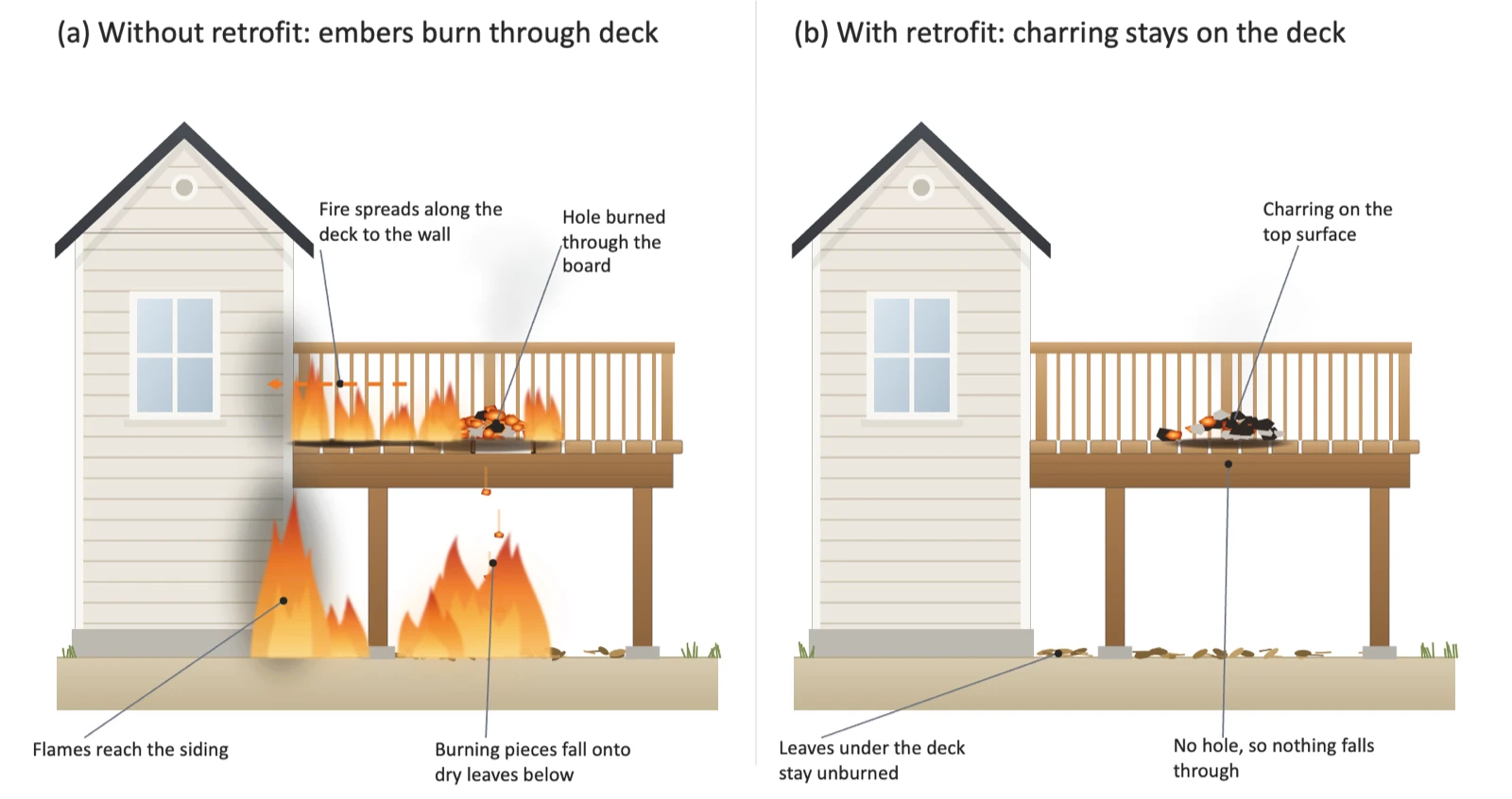
We set out to further characterize the vulnerability of decks to embers, and test proprietary methods we developed to protect them. We created a full section of deck, including a miniature support structure. Our tests assessed how well our Stand-developed retrofit device ultimately limits fire propagation.
Fully improving a deck's fire resistance usually means replacing the boards as well as its support structure with different materials. This process can be very expensive. Stand's proprietary retrofit, installed on an existing deck, does not require any material replacement and is designed to enhance a deck's survivability with minimal invasiveness. In these tests it kept ember damage to the surface of the board, preventing propagation along the surface. When a deck fire is contained to a small area, less of the deck has to be replaced after the fire, and more importantly, if it prevents spread to the main structure, then it can save the home.
How Moisture Content Affects the Way a Shrub Burns
How much water a plant holds, called fuel moisture content (FMC), has a significant effect on how it burns. FMC is technically defined as the ratio of water mass to the dry mass of vegetation. In prior research, where small Douglas fir branches were heated in a controlled stream of hot air, moisture had little effect on the temperature needed to ignite them and mainly changed how long ignition took (Valdivia et al., 2025).
We wanted to study two important variations to this prior work. Firstly, what happens when the source of heat is removed after some initial ignition: at what FMC is the plant able to sustain burn independently? Secondly, what happens differently at the full shrub scale compared to a small branch, which is an important scale of study for our business and customers.
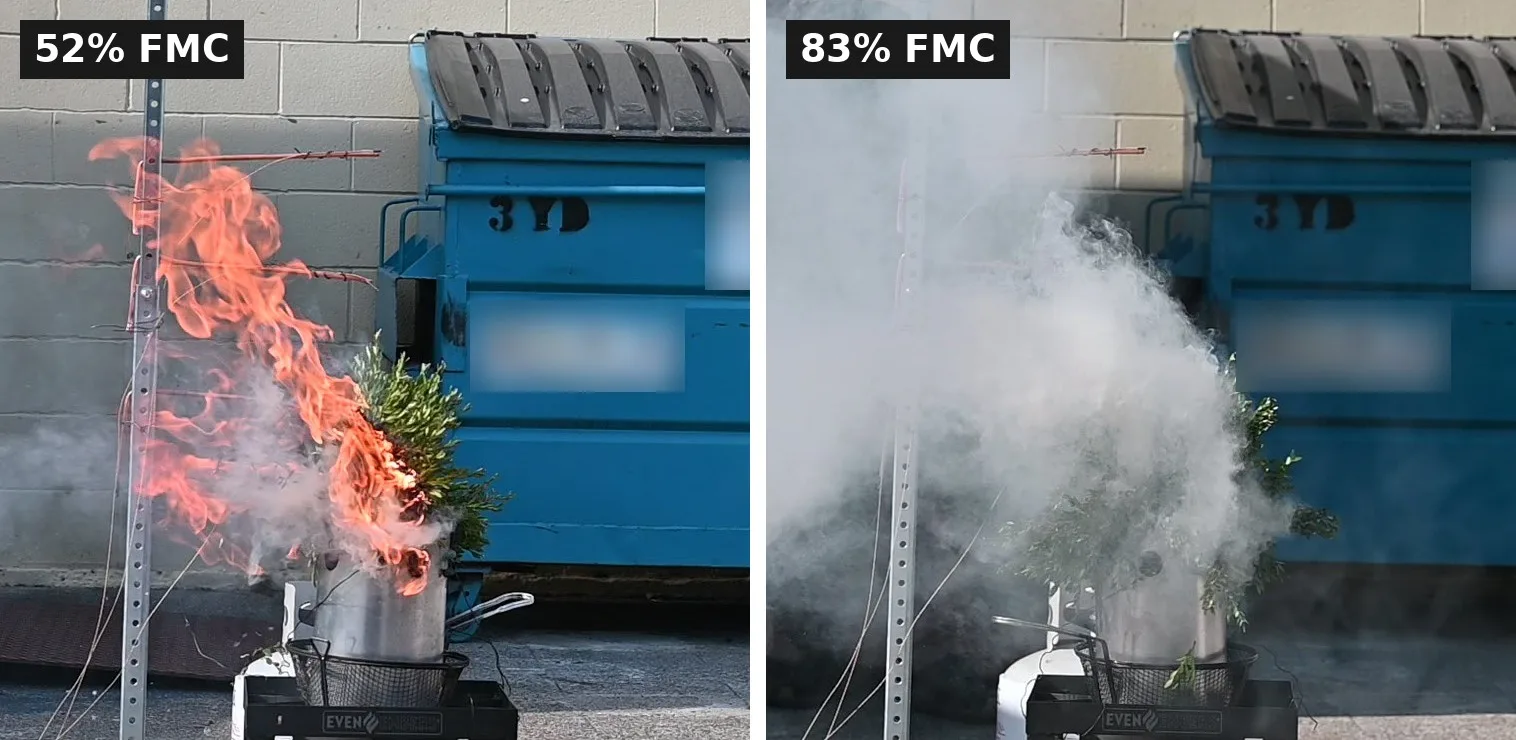
We used six small boxwood shrubs, a common hedge plant, each at a different FMC. We lit each one with a propane torch, took the torch away, and watched how the burning progressed.
The two driest shrubs kept burning after the torch was removed, with flames close to 2 meters (about 6 feet) tall. On the other four wetter shrubs, the flames went out within seconds of removing the torch, never fully catching fire. Our method demonstrated that, at this scale, moisture strongly affects whether a shrub could sustain a flame, which was not apparent in tests on single branches ignited at lower temperatures by a hot air stream in a lab. We now understand the range of FMC where this boxwood shrub will burn under self-sustained conditions. We have also demonstrated a test method that we can apply to other species of vegetation.
Measurements on whole, living shrubs are still scarce in the fire science literature, so these tests add to that record in a meaningful way, and we will also use them both to improve our models and to advise customers on which plants near a home matter the most.
The usual advice for homeowners still applies: Keep plants away from the house, keep any that are near to the house healthy and watered, and clear out dead material. Our guide to fire-hazardous vegetation covers what to look for.
What's Next
We plan to extend our test campaigns to a wider range of wind speeds, plant species, moisture levels, and experiment sizes. The goal is to find more ways to protect existing homes, like the deck retrofit we tested above, and to give customers more specific guidance about the vegetation around their homes.